Oil on canvas
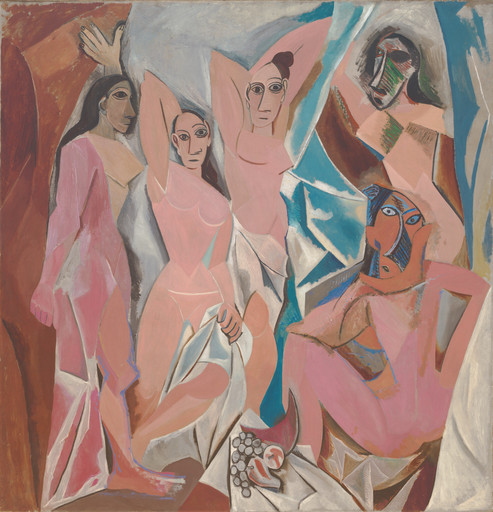
Pablo Picasso began Les Demoiselles d’Avignon during the winter of 1906-7, in his cramped, cluttered Parisian studio. The following summer, visitors expressed shock upon seeing the massive canvas—not yet formally titled—and its radically compressed, strikingly fractured forms. But when the painting was exhibited publicly for the first time in 1916, some viewers regarded it as a turning point in the history of modern art.
It was around the time of the 1916 exhibition that Les Demoiselles d’Avignon received its current title, which refers to sex workers on the carrer d’Avinyó (Avignon Street) in Barcelona, the city where Picasso spent his youth. The canvas centers on five women whose figures are composed of angular lines and flattened, splintered planes. To create them, Picasso engaged with artistic sources ranging from European paintings to African, Iberian, and Oceanic sculptures that had entered French collections through colonial channels. Always in search of visual stimulation, the artist is known to have sought out these works in Parisian museums and studios, and in books, magazines, prints, and photographs.
Les Demoiselles d’Avignon changed dramatically over the course of several months, as Picasso—then a twenty-five-year-old Spanish immigrant eager to establish himself in France—produced hundreds of preparatory sketches and studies. In these works, the artist experimented with different postures, gestures, and expressions using graphite, pen, ink, and paint. For inspiration, he turned to images and objects from diverse time periods and geographical regions, as well as cultural traditions and artistic mediums. The striding pose and clenched fist of the figure at far left, for instance, echo ancient Egyptian and South Asian sculptures, while the stylized facial features of the two figures at right evoke nineteenth-century African and Oceanic masks. Between them are two middle figures whose raised elbows have been traced to Roman copies of ancient Greek sculptures. As a group, these figures also share similarities with multifigure paintings by artists as varied as El Greco, Paul Cézanne, and Henri Matisse.
The five figures in Les Demoiselles d’Avignon are pressed together closely in a shallow space. Nonetheless, they seem to be portrayed from distinct perspectives and in distinct styles. These disjunctions raise important questions about cultural differences. What did Picasso appropriate from Western and non-Western sources while at work on Les Demoiselles d’Avignon? How did the artist understand these appropriations, and how should we?
Art critics and scholars have offered many readings of Picasso’s sources for Les Demoiselles d’Avignon. They have also debated the relationship between this painting and Cubism, the artistic style that Picasso invented with his close friend and collaborator, Georges Braque, during the first decade of the twentieth century. According to Daniel-Henry Kahnweiler, Picasso’s art dealer, Les Demoiselles d’Avignon marked the “beginning of Cubism” due to its fragmented forms and contrasting perspectives. Yet others have denied that the painting is Cubist. Picasso, though, had little interest in disagreements over art historical labels and timelines. “When we invented Cubism, we had no intention of inventing Cubism,” he explained. “We simply wanted to express what was in us.”
2026
Gallery label from 2024
Central to Picasso’s practice was his predilection for borrowing, combining, and transforming references from Western art history, popular visual idioms, and the material culture of colonized peoples from Africa, Oceania, and the Americas. In Les Demoiselles d’Avignon the stylized, geometric features of the two rightmost figures evidence the artist’s keen interest in the formal innovations of African masks and sculpture, which were imported into France via colonial channels, and which Picasso and his peers avidly collected. The stylistic disjunction between these heads and those of the other figures intensifies the painting’s psychological charge and raises questions about cultural difference.
2024
Publication excerpt from MoMA Highlights: 375 Works from The Museum of Modern Art, New York (New York: The Museum of Modern Art, 2019)
This work is as uncomfortable to look at as it is impossible to look away from. No other painting in the history of Western art so boldly, and baldly, confronts the viewer. Three of the five naked protagonists stare outward, trapping us with their gazes, just as the picture’s complicated space, populated by bodies that simultaneously press against and recede from its surface, draws us in. Pictorial conventions are banished and idealized notions of beauty jettisoned. The two rightmost figures’ masklike features are often connected to Picasso’s visit, midway through his work on the painting, to the Musée d’Ethnographie du Trocadéro in Paris—the city’s first anthropological museum. There he had an epiphanic encounter with African and Oceanic art, which influenced the work’s ferocious antinaturalism—the degree to which the depicted figures resist mimetic norms.
Picasso produced an unprecedented quantity of preparatory drawings and paintings for Demoiselles. They speak to his struggle to reinvent Western painting in his own stylistically disjunctive, spatially contradictory, aggressively confrontational terms. The title Les Demoiselles d’Avignon (The women of Avignon) was given to the work around the time of its first public exhibition. It alludes to the prostitutes of Barcelona’s red-light district and foregrounds the psychosexual dimension and erotic content that conjoin with Demoiselles’s explosive form and fuel its continued ability to shock.
MoMA Highlights: 375 Works from The Museum of Modern Art, New York (New York: The Museum of Modern Art, 2019)
Explore more
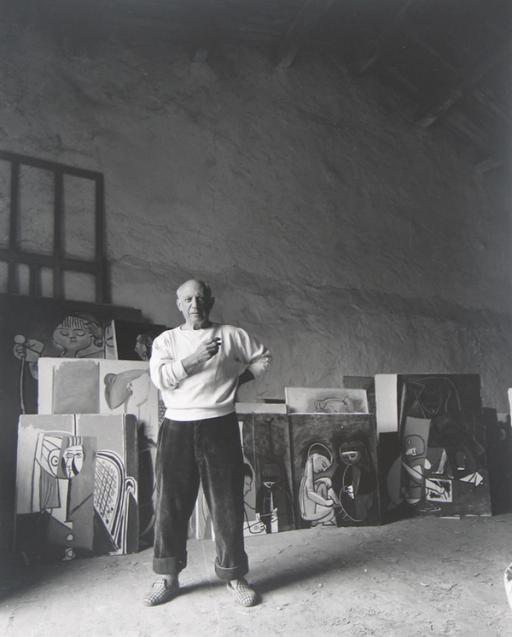
Pablo Picasso
Spanish, 1881–1973 1251 works onlineWith these words, Picasso shed light on two central principles of his artistic production over nearly 80 years: his openness to a diverse range of styles, subject matters, and mediums, and his resistance to the notion that change in art necessarily corresponds to improvement or progress.
Learn more →
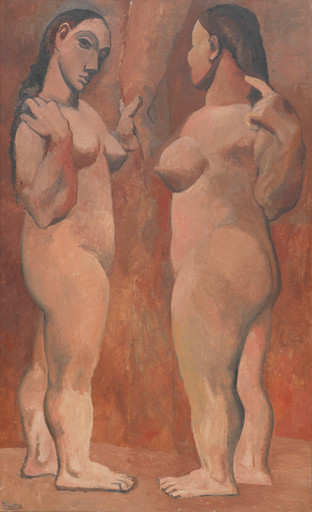
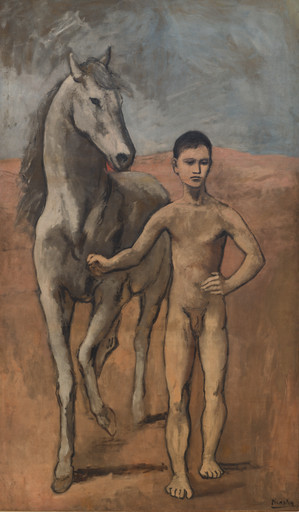
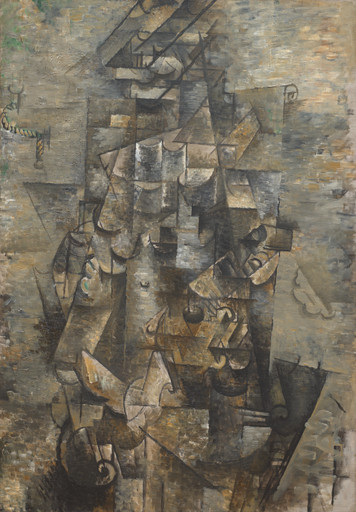
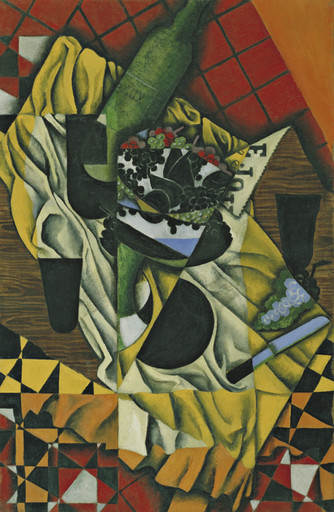
Cubism
An artistic style invented in Paris during the first decade of the 20th century, Cubism was soon adopted by an international network of artists who sought to create a new art for a new century.
Learn more →
Modern art
Art made from the 1880s to the 1970s—a time marked by the growth of cities, the rise of industry, a surge in technologies, and the development of mass media.
Learn more →

Primitive art
A term that has been used to refer to the art of various historical European periods and of non-Western societies.
Learn more →
Picasso’s Les Demoiselles d’Avignon
Gallery 502Legend has it that Pablo Picasso’s Les Demoiselles d’Avignon shocked those who first saw it in his Paris studio in 1907.
Learn more →
Audio
Audio from the playlist Collection 1880s–1940s
Audio from the playlist Verbal Descriptions
From MoMA Design Store


Installation views
We have identified this work in the following photos from our exhibition history.
Provenance Research Project
This work is included in the Provenance Research Project, which investigates the ownership history of works in MoMA's collection.
The artist, Paris. 1907 - 1924
Jacques Doucet (1853-1929), Neuilly (Paris). Purchased from Picasso in February 1924 - 1929
Madame Jacques Doucet (Jeanne Roger), Neuilly. 1929 - September 1937
Jacques Seligmann & Co., New York. Purchased from Madame Doucet in September 1937
The Museum of Modern Art, New York. Purchased from Seligmann, through the Lillie P. Bliss Bequest, in 1937. Transaction completed in 1939
Provenance research is a work in progress, and is frequently updated with new information. If you have any questions or information to provide about the listed works, please email [email protected] or write to:
Provenance Research Project
The Museum of Modern Art
11 West 53 Street
New York, NY 10019
Licensing
Artwork or archival images
If you would like to reproduce an image of a work of art in MoMA's collection, or an image of a MoMA publication or archival material (including installation views, checklists, and press releases), please contact Art Resource (publication in North America) or Scala Archives (publication in all other geographic locations).
Audio and film clips
MoMA licenses archival audio and select out of copyright film clips from our film collection. At this time, MoMA produced video cannot be licensed by MoMA/Scala. All requests to license archival audio or out of copyright film clips should be addressed to Scala Archives at [email protected]. Motion picture film stills cannot be licensed by MoMA/Scala. For access to motion picture film stills for research purposes, please contact the Film Study Center at [email protected]. For more information about film loans and our Circulating Film and Video Library, please visit Circulating Film and Video Library.
Text from a publication or the archives
If you would like to reproduce text from a MoMA publication, please email [email protected]. If you would like to publish text from MoMA's archival materials, please fill out this permission form and send to [email protected].
Feedback
This record is a work in progress. If you have additional information or spotted an error, please fill out this feedback form.