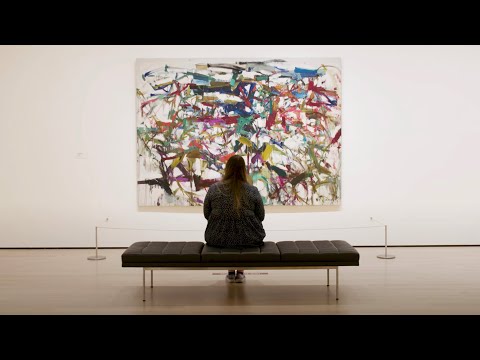
Mitchell’s Ladybug presents an apparently spontaneous—but in fact carefully plotted—accumulation of brushstrokes. Staccato arcs and dashes of marigold, mauve, dark berry, and brown seem to leap off the canvas, while excess pigment dribbles downward. Colors abut one another, overlap, and mix on the picture’s surface, dense paint merging with liquid drips, and flatness with relief. The chromatic web appears to hover over an empty ground, which is actually composed of several layers of white paint.
In 1957, the year in which she made Ladybug, Mitchell said of her process, “The freedom in my work is quite controlled.” She meticulously applied each color, attentive to the relationships between them and to the weight of each brushstroke. In this painting and others of this period, Mitchell, unlike many of her Abstract Expressionist contemporaries, rejected an allover compositional approach, preferring a balance of figure and ground—even in a fully abstract image.
Throughout her long career, Mitchell referred to the matter of her paintings as “feelings,” or memories of distinct times and places, the uneven flow of which she fixed in paint. Mitchell was thirty-two and living in New York when she painted Ladybug. Here, as in her other works, she aimed not to describe nature, but (as she put it) “to paint what it leaves me with.”
MoMA Highlights: 375 Works from The Museum of Modern Art, New York (New York: The Museum of Modern Art, 2019)
Gallery label from Making Space: Women Artists and Postwar Abstraction , April 19 - August 13, 2017.
In Ladybug, Mitchell abuts pure colors with colors that mix on the canvas, dense paint with liquid drips, flatness with relief. White patches of pigment aerate the energized fields of color. Although Mitchell was considered one of the principal figures of the second generation of Abstract Expressionists that emerged in the mid-1950s, she also challenged the conventional wisdom of the New York School. While her paintings are abstract, their starting point was nature, which she set out not to describe but "to paint what it leaves me with."
Making Space: Women Artists and Postwar Abstraction, April 19 - August 13, 2017.
Explore more
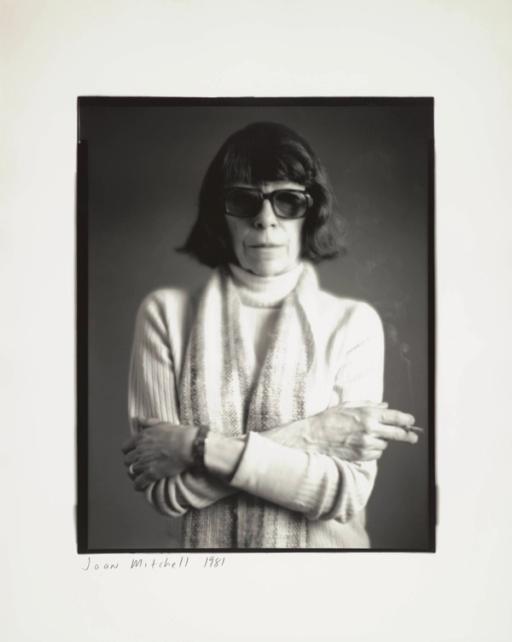
Joan Mitchell
American, 1925–1992 50 works onlineIn expansive canvases like No Rain (1976), Joan Mitchell combined assertive, richly textured brushwork with vibrant, lyrical color. Born in Chicago, she moved to New York in 1949, where she became actively involved in the downtown avant-garde art scene, establishing herself as a central figure among the second generation of Abstract Expressionists .
Learn more →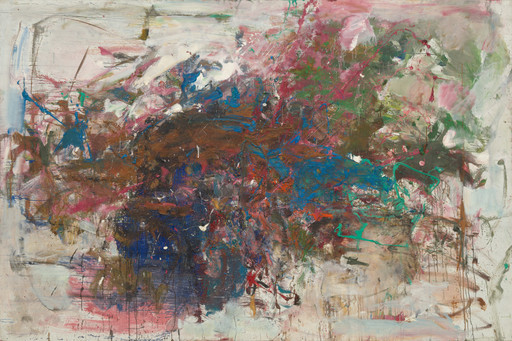
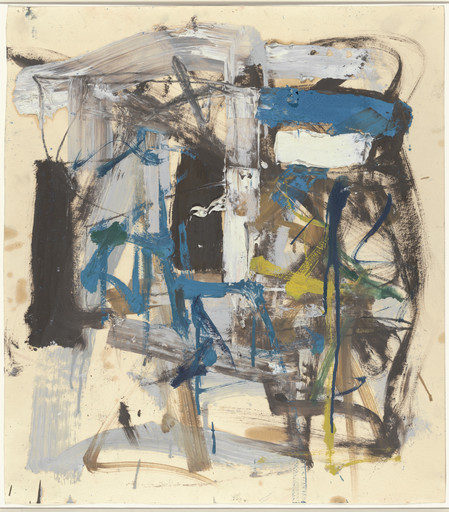
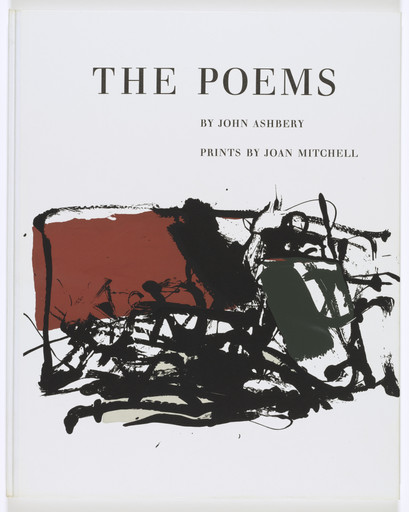
Action painting
Art critic Harold Rosenberg coined the term “action painting” in 1952 to describe the work of artists who painted using bold gestures that engaged more of the body than traditional easel painting.
Learn more →


New York School
An interdisciplinary, avant-garde movement of painters, sculptors, poets, dancers, musicians, and composers active in New York City in the 1950s and ’60s.
Learn more →

Painting
A work of art made from paint applied to canvas, wood, paper, or another support.
Learn more →



Articles and videos
From MoMA Design Store


Installation views
We have identified this work in the following photos from our exhibition history.
Licensing
Artwork or archival images
If you would like to reproduce an image of a work of art in MoMA's collection, or an image of a MoMA publication or archival material (including installation views, checklists, and press releases), please contact Art Resource (publication in North America) or Scala Archives (publication in all other geographic locations).
Audio and film clips
MoMA licenses archival audio and select out of copyright film clips from our film collection. At this time, MoMA produced video cannot be licensed by MoMA/Scala. All requests to license archival audio or out of copyright film clips should be addressed to Scala Archives at [email protected]. Motion picture film stills cannot be licensed by MoMA/Scala. For access to motion picture film stills for research purposes, please contact the Film Study Center at [email protected]. For more information about film loans and our Circulating Film and Video Library, please visit Circulating Film and Video Library.
Text from a publication or the archives
If you would like to reproduce text from a MoMA publication, please email [email protected]. If you would like to publish text from MoMA's archival materials, please fill out this permission form and send to [email protected].
Feedback
This record is a work in progress. If you have additional information or spotted an error, please fill out this feedback form.